
Solar Coolant −12 °C
Description
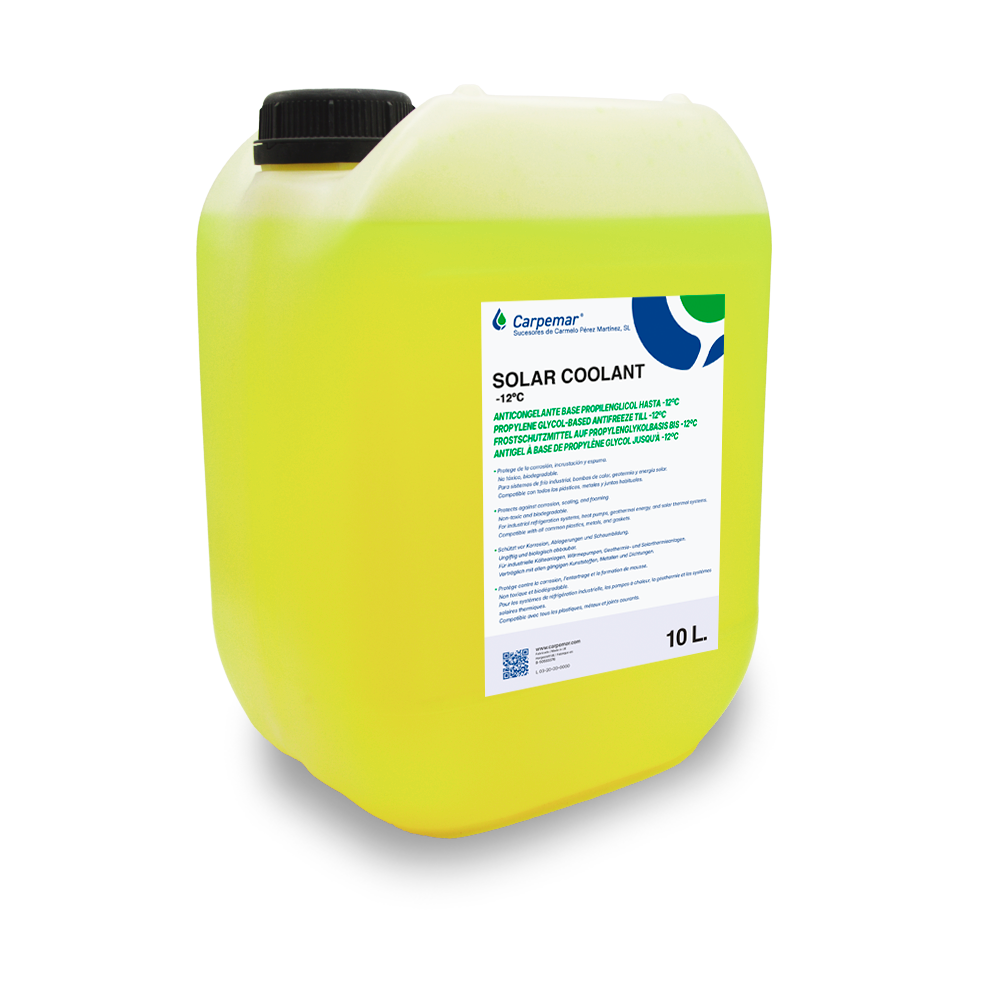
This new propylene glycol-based antifreeze-coolant formulation is specifically designed for solar thermal energy systems where low toxicity is required.
The product is ready for direct use in the system; it must not be diluted with water as this would compromise its antifreeze and anti-corrosion properties.
The most effective hybrid additive package used in this product keeps the circuit in perfect working order for longer periods than conventional products.
It provides special protection for iron, copper, brass and steel alloys.
Its fluorescent yellow color makes it easier to detect leaks in the circuit.
It contains no nitrites or amines, substances which can form nitrosamines, potential carcinogens. Free from borates and triazoles and their harmful effects on health.
Packaging formats
Advantages
- Prevents damage to the circuit caused by freezing.
- It raises the boiling point, reducing overheating problems.
- Prevents corrosion.
- Prevents deposits in the cooling circuit.
- Biodegradable.
- Non-toxic.
Technical data
| Property | Value |
|---|---|
| Appearance | Clear yellow liquid |
| Propylene glycol content | 25 % w/w |
| Freezing point | −10 °C |
| Protection temperature | −12 °C |
| Break temperature | −14 °C |
| Boiling point (2 bar) | 127 °C |
| pH (20 °C) | 8 – 9 |
The data provided is based on our own measurements and relevant literature. It does not form part of the technical specifications.
Protection temperature: the freezing point according to ASTM D 1177 is the temperature at which the first ice crystal forms. The DIN 51583 standard specifies the temperature at which the product ceases to flow and there is a risk to the integrity of the circuit. Between these two temperatures, there is a mixture of ice crystals and unfrozen fluid which flows without any increase in volume and therefore without any risk of bursting.
Approvals / Specifications
Corrosion protection
The results of the test in accordance with ASTM D 1384, which assesses corrosion on different metals, are shown below.
| Material | Solar Coolant −12 °C | ASTM D 3306 max. |
|---|---|---|
| Copper | 5.9 | 10 |
| Solder | 0.5 | 30 |
| Brass | 1.3 | 10 |
| Steel | −1.0 | 10 |
| Cast iron | 0.7 | 10 |
| Aluminum | 0.1 | 30 |
The results obtained are given in mg per metal sample tested. A negative result indicates a net gain due to the formation of a stable protective layer on the metal’s surface.
Description of the ASTM D 1384 test: in this test method, metal specimens typical of those found in engine cooling systems are fully immersed in aerated solutions of engine coolant containing corrosive water for 336 hours at 88 °C. The corrosion-inhibiting properties of the test solution are evaluated on the basis of the changes in weight of the specimens. Each test is carried out in triplicate and the average change in weight is determined for each metal.
Compatible materials
Solar Coolant −12 °C is compatible with standard materials used in thermal circuits. The table below shows the plastics, sealants and elastomers compatible with the product. The data was compiled from specific literature and proprietary tests.
| Name | Abbreviation |
|---|---|
| Rubber – isobutene-isoprene rubber | IIR |
| Chloropropene rubber | CR |
| Ethylene-propylene-diene terpolymer rubber | EPDM |
| Fluorocarbon elastomers | FPM |
| Natural polypropylene (up to 80 °C) | NR |
| Poly(nitrile-butadiene) rubber | NBR |
| Polyacetal | POM |
| Polyamide (up to 115 °C) | PA |
| Polybutylene | PB |
| High/low-density polyethylene | LD-PE / HDPE |
| Cross-linked polyethylene | EVP |
| Polypropylene | PP |
| Poly(tetrafluoroethylene) | PTFE |
| Rigid poly(vinyl chloride) | PVC h |
| Silicone | Si |
| Styrene-butadiene rubber (up to 100 °C) | SBR |
| Unsaturated polyester (thermoset) | UP |
Phenolic resins, plasticised PVC and polyurethane elastomers are not compatible with Solar Coolant −12 °C.
Zinc is not compatible with propylene glycol or its mixtures with water; avoid using zinc or galvanized tanks.
If there is galvanized material in the system, a whitish sediment will initially appear as the zinc dissolves and precipitates as oxide. Once this solid has been removed, the exposed carbon steel will be protected by Solar Coolant −12 °C without requiring any further action on the system.
Thermophysical tables
Thermodynamic properties of Solar Coolant −12 °C as a function of temperature.
Solar Coolant −12 °C
| Temperature °C |
Density kg/m³ |
Heat capacity kJ/kg·K |
Thermal conductivity W/m·K |
Dynamic viscosity mPa·s |
Kinematic viscosity mm²/s |
Prandtl number | Thermal expansion coefficient β (·10⁻⁵ 1/K) |
Vapor pressure mbar |
|---|---|---|---|---|---|---|---|---|
| −12 | 1,029.4 | 3.38 | 0.385 | 10.5 | 10.2 | 89.8 | 18.67 | 0 |
| −10 | 1,029.0 | 3.39 | 0.388 | 9.4 | 9.1 | 79.9 | 21.27 | 0 |
| −5 | 1,027.7 | 3.41 | 0.396 | 7.2 | 7.0 | 60.7 | 27.26 | 0 |
| 0 | 1,026.2 | 3.43 | 0.404 | 5.6 | 5.4 | 47.0 | 32.60 | 0 |
| 10 | 1,022.4 | 3.47 | 0.418 | 3.6 | 3.5 | 29.8 | 41.56 | 0 |
| 20 | 1,017.8 | 3.51 | 0.432 | 2.5 | 2.4 | 20.1 | 48.65 | 0 |
| 30 | 1,012.6 | 3.55 | 0.444 | 1.8 | 1.8 | 14.4 | 54.25 | 0 |
| 40 | 1,006.9 | 3.58 | 0.456 | 1.4 | 1.3 | 10.7 | 58.65 | 24 |
| 50 | 1,000.9 | 3.62 | 0.467 | 1.1 | 1.1 | 8.3 | 62.07 | 119 |
| 60 | 994.5 | 3.65 | 0.478 | 0.9 | 0.9 | 6.7 | 64.70 | 208 |
| 70 | 988.0 | 3.67 | 0.488 | 0.7 | 0.7 | 5.6 | 66.68 | 311 |
| 80 | 981.4 | 3.70 | 0.497 | 0.6 | 0.6 | 4.7 | 68.14 | 453 |
| 90 | 974.7 | 3.73 | 0.506 | 0.6 | 0.6 | 4.1 | 69.15 | 656 |
| 100 | 968.0 | 3.75 | 0.514 | 0.5 | 0.5 | 3.7 | 69.81 | 943 |
Directions for use
Before filling, the circuit must be flushed with water to remove scale and assembly residues, as well as flux residues, particularly where fluxes containing chloride, fluoride or borax have been used.
Following the pressure test – during which the exact volume of the circuit can also be determined using a meter – the circuit must be filled with a mixture of antifreeze and water, or with pure antifreeze, and this must be mixed within the circuit via recirculation. It is not advisable to leave the circuit empty after the pressure test, particularly if carbon steel is present, as it is highly susceptible to damage.
It is recommended that the circuit be properly bled after commissioning to remove any air pockets.
In the case of a circuit already in use, after draining the previous antifreeze, it must be flushed with water to remove sediment and particles before filling the system with Solar Coolant −12 °C. Existing corrosion can significantly shorten the product’s service life. If corrosion is detected, corrective measures must be taken before filling the system. Depending on the condition of the previous fluid, it is recommended to clean the circuit before filling it, for example, with CS-LTV or Luzar® LD.
It is recommended to use Teflon or hemp tape to seal threaded joints. Check the compatibility of other products with propylene glycol before using them.
The product is ready for use; do not dilute or mix with other products.
Mixing with other types of antifreeze should be avoided due to the possibility of incompatibility that could shorten the product’s service life. To enquire about specific compatibilities, please contact our technical department by email: carpemar@carpemar.com.
Avoid prolonged periods of inactivity of the system, as the stability of the product may be affected and its service life significantly reduced.
Minor corrosion damage may become more visible after filling with Solar Coolant −12 °C due to this product’s lower surface tension.
Operating temperature
Continuous temperatures above 170 °C cause premature ageing of the propylene glycol.
Temperatures above 200 °C cause the gradual degradation of the antifreeze’s chemical properties, which jeopardizes the reliability of the system’s operation.
The optimum operating temperature range is from the mixture’s freezing point to 130 °C.
In the case of open systems or those where oxygen enters (for example, via valves), the maximum temperature is lower.
Maintenance – Service life
The service life of Solar Coolant −12 °C is at least five years in a closed circuit operating between the freezing point and 100 °C. Practical experience shows that the fluid does not degrade under the operating conditions described in this section, resulting in a longer service life.
To check the product’s performance, the most important parameters are the pH and glycol concentration measurements. It is recommended that these parameters be checked annually.
The glycol content must not differ from the initial value. The appropriate pH range is between 7.5 and 9.0. Outside this range, the product must be analyzed to determine the cause and the procedure to be followed.
Dosage
Precautions
Solar Coolant −12 °C is a non-flammable and non-corrosive product. It is non-toxic. In any case, it is recommended to follow good industrial practice when handling chemicals.
Avoid contact with the eyes. In the event of contact, rinse the eye with plenty of water for 10 minutes. Do not swallow and keep out of the reach of children.
When stored in its original, tightly sealed containers at temperatures between 5 and 35 °C away from direct sunlight, the product retains its properties for at least 24 months.
Downloadable documents
Find all the relevant documentation about the product: technical data sheets and safety data sheets.