
Thermosol Concentrate
Description
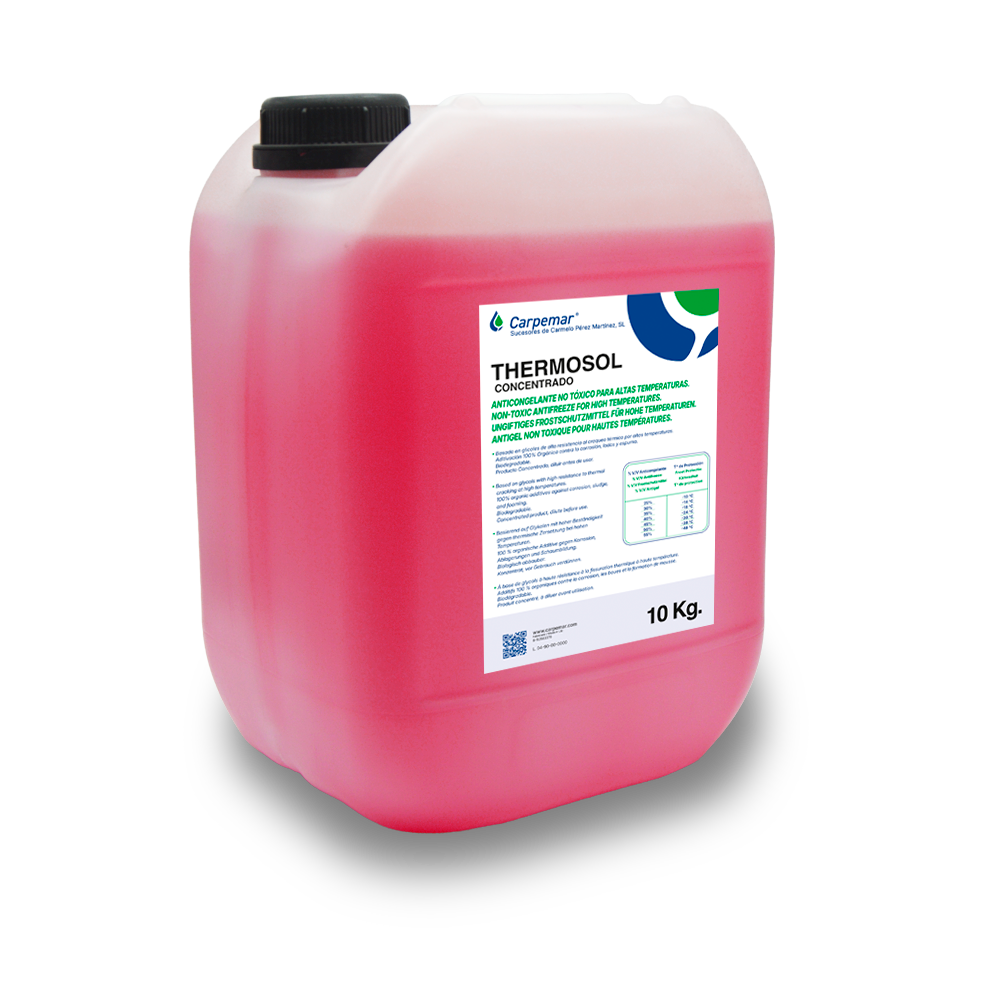
Thermosol® Concentrate is a product formulated with high-boiling-point glycols that offer excellent resistance to degradation at high temperatures. It withstands high thermal loads, retaining its properties for longer than antifreeze products based on monoethylene glycol or propylene glycol.
The state-of-the-art organic additives used in this product keep the circuit in perfect working order for longer periods than conventional inorganic products.
The product protects the metal components typically found in thermal circuits. It optimizes heat transfer and thus improves system performance.
Its red color makes it easy to detect leaks in the system. Thanks to its formulation based on non-toxic glycol, it is safe to handle.
It contains no nitrites or amines, substances that can form nitrosamines, i.e. potential carcinogens. It contains no phosphates or borates, which have come under scrutiny due to their harmful impact on the environment. It contains no silicates, nitrates, 2EH or heavy metals.
Packaging formats
Advantages
- Prevents damage to the circuit caused by freezing.
- Raises the boiling point, reducing overheating problems.
- Prevents corrosion of iron, steel, copper, brass, aluminum and welds.
- Biodegradable.
- Contains triethylene glycol; non-toxic.
- Slightly hazardous to water; classified as WGK1 following self-assessment.
Technical data
| Property | Value |
|---|---|
| Appearance | Red transparent liquid |
| Contents of triethylene glycol | 90 % P/P |
| pH 50 % V/V | 8 – 9 |
Approvals / Specifications
Corrosion protection
Glycol-water mixtures are more corrosive than pure water; they must be used with additives to protect the integrity of the system.
The results of the tests assessing the corrosion of various metals, carried out in accordance with the ASTM D 1384 standard, are shown below.
| Material | Thermosol® Concentrate 50 % V/V | ASTM D 3306 max. |
|---|---|---|
| Copper | 0.5 | 10 |
| Solder | 0.1 | 30 |
| Brass | −0.5 | 10 |
| Mild steel | −1.0 | 10 |
| Cast iron | −3.7 | 10 |
| Aluminum | 2.0 | 30 |
The results are expressed in mg/coupon. A negative result indicates an increase in weight due to the formation of a stable protective layer on the metal’s surface.
Description of the ASTM D 1384 test: in this test method, samples made from metals typically found in engine cooling systems are completely immersed in aerated solutions of engine coolant mixed with corrosive water for 336 hours at 88 °C. The anti-corrosion properties of the test solution are assessed on the basis of changes in the weight of the samples. Each test is carried out in triplicate and the average change in weight is determined for each metal.
Compatible materials
Thermosol® Concentrate is compatible with materials typically used in thermal circuits. The table below shows the plastics, sealants and elastomers that are compatible with the product. The data is taken from specialist literature and our own tests.
Compatibility with elastomers
| Material | 25 °C | 80 °C | 160 °C |
|---|---|---|---|
| Adiprene™ L-100 | OK | NR | NR |
| Black Rubber 3773 | OK | NR | NR |
| Buna N (o 25) | OK | OK | — |
| Buna S | OK | Acceptable | NR |
| Butyl Rubber | OK | OK | — |
| Compressed Asbestos | OK | OK | Acceptable |
| EPDM | OK | OK | OK |
| EPR Rubber | OK | OK | OK |
| Hycar™ D-24 | OK | Acceptable | — |
| Hypalon™ | OK | NR | NR |
| Kalrez™ | OK | OK | OK |
| Natural Rubber Gum | OK | NR | NR |
| Neoprene 7797 | OK | Acceptable | — |
| Red Rubber 107 | OK | NR | NR |
| Saraloy™ 300 | OK | NR | NR |
| Silicone No. 65 | OK | OK | — |
| Thiokol™ 3060 | OK | NR | NR |
| Viton™ A | OK | OK | NR |
OK: recommended · NR: not recommended · —: no data.
Phenolic resins, plasticised PVC and polyurethanes are not compatible with Thermosol® and its mixtures with water.
Zinc is not compatible with triethylene glycol or its mixtures with water; avoid using zinc-coated tanks.
If there is galvanised material in the system, a whitish sediment will initially appear as the zinc dissolves and precipitates as oxide. Once this solid has been removed, the exposed carbon steel will be protected by Thermosol® within the specified dosage range without requiring any further action on the system.
Thermophysical tables
Thermodynamic properties of Thermosol® Concentrate dilutions in water as a function of temperature.
Thermosol® 30 % V/V
| Temperature °C |
Density kg/m³ |
Specific heat kJ/kg·K |
Thermal conductivity W/m·K |
Dynamic viscosity mPa·s |
Kinematic viscosity mm²/s |
Prandtl number | Vapor pressure mbar |
|---|---|---|---|---|---|---|---|
| −10 | 1,064.3 | 3.67 | 0.471 | 9.38 | 8.82 | 73.03 | 3 |
| 0 | 1,059.3 | 3.68 | 0.474 | 5.45 | 5.14 | 42.31 | 6 |
| 10 | 1,054.3 | 3.70 | 0.476 | 3.71 | 3.52 | 28.88 | 11 |
| 20 | 1,049.3 | 3.72 | 0.478 | 2.76 | 2.63 | 21.51 | 22 |
| 30 | 1,044.3 | 3.74 | 0.479 | 2.17 | 2.08 | 16.93 | 40 |
| 40 | 1,039.3 | 3.77 | 0.481 | 1.77 | 1.70 | 13.84 | 70 |
| 50 | 1,034.3 | 3.79 | 0.483 | 1.48 | 1.43 | 11.64 | 117 |
| 60 | 1,029.3 | 3.82 | 0.485 | 1.27 | 1.23 | 9.99 | 189 |
| 70 | 1,024.3 | 3.84 | 0.486 | 1.10 | 1.08 | 8.73 | 296 |
| 80 | 1,019.3 | 3.87 | 0.488 | 0.97 | 0.96 | 7.73 | 450 |
| 90 | 1,014.3 | 3.90 | 0.490 | 0.87 | 0.86 | 6.92 | 666 |
| 100 | 1,009.3 | 3.93 | 0.492 | 0.78 | 0.77 | 6.25 | 963 |
| 110 | 1,004.3 | 3.97 | 0.493 | 0.71 | 0.71 | 5.70 | 1,362 |
| 120 | 999.3 | 4.00 | 0.495 | 0.65 | 0.65 | 5.23 | 1,887 |
| 130 | 994.3 | 4.04 | 0.497 | 0.59 | 0.60 | 4.83 | 2,568 |
| 140 | 989.3 | 4.07 | 0.499 | 0.55 | 0.55 | 4.48 | 3,437 |
| 150 | 984.3 | 4.11 | 0.500 | 0.51 | 0.52 | 4.18 | 4,530 |
| 160 | 979.3 | 4.15 | 0.502 | 0.47 | 0.48 | 3.92 | 5,886 |
| 170 | 974.3 | 4.19 | 0.504 | 0.44 | 0.45 | 3.69 | 7,547 |
| 180 | 969.3 | 4.24 | 0.505 | 0.42 | 0.43 | 3.48 | 9,560 |
Thermosol® 35 % V/V
| Temperature °C |
Density kg/m³ |
Specific heat kJ/kg·K |
Thermal conductivity W/m·K |
Dynamic viscosity mPa·s |
Kinematic viscosity mm²/s |
Prandtl number | Vapor pressure mbar |
|---|---|---|---|---|---|---|---|
| −14 | 1,072.4 | 3.55 | 0.452 | 13.64 | 12.72 | 107.22 | 2 |
| −10 | 1,070.4 | 3.56 | 0.453 | 10.89 | 10.17 | 85.59 | 3 |
| 0 | 1,065.4 | 3.58 | 0.455 | 6.86 | 6.44 | 54.04 | 6 |
| 10 | 1,060.4 | 3.61 | 0.456 | 4.77 | 4.50 | 37.69 | 11 |
| 20 | 1,055.4 | 3.63 | 0.457 | 3.53 | 3.34 | 28.02 | 22 |
| 30 | 1,050.4 | 3.65 | 0.458 | 2.73 | 2.60 | 21.78 | 40 |
| 40 | 1,045.4 | 3.68 | 0.459 | 2.18 | 2.09 | 17.50 | 69 |
| 50 | 1,040.4 | 3.71 | 0.460 | 1.79 | 1.72 | 14.43 | 116 |
| 60 | 1,035.4 | 3.74 | 0.461 | 1.50 | 1.45 | 12.15 | 187 |
| 70 | 1,030.4 | 3.77 | 0.462 | 1.28 | 1.24 | 10.40 | 292 |
| 80 | 1,025.4 | 3.80 | 0.463 | 1.10 | 1.07 | 9.03 | 444 |
| 90 | 1,020.4 | 3.83 | 0.464 | 0.96 | 0.94 | 7.93 | 658 |
| 100 | 1,015.4 | 3.87 | 0.465 | 0.85 | 0.83 | 7.04 | 951 |
| 110 | 1,010.4 | 3.90 | 0.466 | 0.75 | 0.74 | 6.30 | 1,344 |
| 120 | 1,005.4 | 3.94 | 0.467 | 0.67 | 0.67 | 5.69 | 1,863 |
| 130 | 1,000.4 | 3.98 | 0.468 | 0.61 | 0.61 | 5.16 | 2,536 |
| 140 | 995.4 | 4.02 | 0.469 | 0.55 | 0.55 | 4.72 | 3,394 |
| 150 | 990.4 | 4.06 | 0.470 | 0.50 | 0.51 | 4.34 | 4,473 |
| 160 | 985.4 | 4.10 | 0.471 | 0.46 | 0.47 | 4.00 | 5,811 |
| 170 | 980.4 | 4.14 | 0.472 | 0.42 | 0.43 | 3.71 | 7,451 |
| 180 | 975.4 | 4.19 | 0.473 | 0.39 | 0.40 | 3.46 | 9,439 |
Thermosol® 40 % V/V
| Temperature °C |
Density kg/m³ |
Specific heat kJ/kg·K |
Thermal conductivity W/m·K |
Dynamic viscosity mPa·s |
Kinematic viscosity mm²/s |
Prandtl number | Vapor pressure mbar |
|---|---|---|---|---|---|---|---|
| −20 | 1,081.6 | 3.43 | 0.251 | 29.29 | 27.08 | 400.58 | 1 |
| −10 | 1,076.6 | 3.46 | 0.251 | 16.15 | 15.00 | 222.13 | 3 |
| 0 | 1,071.6 | 3.48 | 0.252 | 9.85 | 9.19 | 136.32 | 5 |
| 10 | 1,066.6 | 3.51 | 0.252 | 6.46 | 6.05 | 89.97 | 11 |
| 20 | 1,061.6 | 3.54 | 0.252 | 4.46 | 4.21 | 62.66 | 21 |
| 30 | 1,056.6 | 3.57 | 0.252 | 3.22 | 3.05 | 45.50 | 39 |
| 40 | 1,051.6 | 3.60 | 0.252 | 2.40 | 2.28 | 34.16 | 68 |
| 50 | 1,046.6 | 3.63 | 0.252 | 1.83 | 1.75 | 26.35 | 114 |
| 60 | 1,041.6 | 3.66 | 0.253 | 1.44 | 1.38 | 20.80 | 184 |
| 70 | 1,036.6 | 3.69 | 0.253 | 1.15 | 1.11 | 16.73 | 288 |
| 80 | 1,031.6 | 3.73 | 0.253 | 0.93 | 0.90 | 13.69 | 438 |
| 90 | 1,026.6 | 3.76 | 0.253 | 0.76 | 0.74 | 11.36 | 648 |
| 100 | 1,021.6 | 3.80 | 0.253 | 0.64 | 0.62 | 9.54 | 937 |
| 110 | 1,016.6 | 3.84 | 0.253 | 0.54 | 0.53 | 8.10 | 1,325 |
| 120 | 1,011.6 | 3.88 | 0.254 | 0.45 | 0.45 | 6.95 | 1,836 |
| 130 | 1,006.6 | 3.92 | 0.254 | 0.39 | 0.39 | 6.02 | 2,499 |
| 140 | 1,001.6 | 3.96 | 0.254 | 0.34 | 0.34 | 5.25 | 3,344 |
| 150 | 996.6 | 4.00 | 0.254 | 0.29 | 0.29 | 4.61 | 4,407 |
| 160 | 991.6 | 4.05 | 0.254 | 0.26 | 0.26 | 4.08 | 5,726 |
| 170 | 986.6 | 4.09 | 0.254 | 0.23 | 0.23 | 3.63 | 7,343 |
| 180 | 981.6 | 4.14 | 0.255 | 0.20 | 0.20 | 3.25 | 9,301 |
Thermosol® 45 % V/V
| Temperature °C |
Density kg/m³ |
Specific heat kJ/kg·K |
Thermal conductivity W/m·K |
Dynamic viscosity mPa·s |
Kinematic viscosity mm²/s |
Prandtl number | Vapor pressure mbar |
|---|---|---|---|---|---|---|---|
| −27 | 1,093.6 | 3.30 | 0.413 | 75.49 | 69.03 | 603.47 | 0 |
| −20 | 1,090.1 | 3.32 | 0.413 | 42.37 | 38.87 | 340.30 | 1 |
| −10 | 1,085.1 | 3.35 | 0.414 | 21.81 | 20.10 | 176.37 | 2 |
| 0 | 1,080.1 | 3.38 | 0.415 | 12.72 | 11.78 | 103.63 | 5 |
| 10 | 1,075.1 | 3.41 | 0.415 | 8.08 | 7.52 | 66.34 | 11 |
| 20 | 1,070.1 | 3.44 | 0.416 | 5.46 | 5.11 | 45.19 | 21 |
| 30 | 1,065.1 | 3.47 | 0.416 | 3.87 | 3.63 | 32.28 | 38 |
| 40 | 1,060.1 | 3.50 | 0.417 | 2.85 | 2.68 | 23.92 | 67 |
| 50 | 1,055.1 | 3.54 | 0.417 | 2.16 | 2.04 | 18.27 | 112 |
| 60 | 1,050.1 | 3.57 | 0.418 | 1.67 | 1.59 | 14.31 | 181 |
| 70 | 1,045.1 | 3.61 | 0.419 | 1.33 | 1.27 | 11.44 | 283 |
| 80 | 1,040.1 | 3.65 | 0.419 | 1.07 | 1.03 | 9.31 | 430 |
| 90 | 1,035.1 | 3.69 | 0.420 | 0.88 | 0.85 | 7.69 | 637 |
| 100 | 1,030.1 | 3.73 | 0.420 | 0.73 | 0.70 | 6.43 | 921 |
| 110 | 1,025.1 | 3.77 | 0.421 | 0.61 | 0.59 | 5.45 | 1,302 |
| 120 | 1,020.1 | 3.81 | 0.421 | 0.52 | 0.51 | 4.66 | 1,805 |
| 130 | 1,015.1 | 3.85 | 0.422 | 0.44 | 0.43 | 4.03 | 2,456 |
| 140 | 1,010.1 | 3.89 | 0.423 | 0.38 | 0.38 | 3.50 | 3,287 |
| 150 | 1,005.1 | 3.94 | 0.423 | 0.33 | 0.33 | 3.07 | 4,332 |
| 160 | 1,000.1 | 3.98 | 0.424 | 0.29 | 0.29 | 2.71 | 5,629 |
| 170 | 995.1 | 4.03 | 0.424 | 0.25 | 0.26 | 2.41 | 7,218 |
| 180 | 990.1 | 4.08 | 0.425 | 0.22 | 0.23 | 2.16 | 9,143 |
Thermosol® 50 % V/V
| Temperature °C |
Density kg/m³ |
Specific heat kJ/kg·K |
Thermal conductivity W/m·K |
Dynamic viscosity mPa·s |
Kinematic viscosity mm²/s |
Prandtl number | Vapor pressure mbar |
|---|---|---|---|---|---|---|---|
| −36 | 1,104.5 | 3.16 | 0.392 | 324.99 | 294.24 | 2,621.41 | 0 |
| −30 | 1,101.5 | 3.18 | 0.392 | 166.25 | 150.93 | 1,346.39 | 0 |
| −20 | 1,096.5 | 3.21 | 0.393 | 61.37 | 55.97 | 501.11 | 1 |
| −10 | 1,091.5 | 3.24 | 0.394 | 29.40 | 26.93 | 242.06 | 2 |
| 0 | 1,086.5 | 3.27 | 0.394 | 16.39 | 15.09 | 136.16 | 5 |
| 10 | 1,081.5 | 3.31 | 0.395 | 10.10 | 9.34 | 84.66 | 11 |
| 20 | 1,076.5 | 3.34 | 0.395 | 6.68 | 6.21 | 56.50 | 21 |
| 30 | 1,071.5 | 3.38 | 0.396 | 4.66 | 4.35 | 39.75 | 38 |
| 40 | 1,066.5 | 3.41 | 0.396 | 3.38 | 3.17 | 29.13 | 66 |
| 50 | 1,061.5 | 3.45 | 0.397 | 2.54 | 2.39 | 22.06 | 110 |
| 60 | 1,056.5 | 3.49 | 0.398 | 1.96 | 1.85 | 17.15 | 177 |
| 70 | 1,051.5 | 3.53 | 0.398 | 1.54 | 1.46 | 13.64 | 278 |
| 80 | 1,046.5 | 3.57 | 0.399 | 1.23 | 1.18 | 11.05 | 422 |
| 90 | 1,041.5 | 3.61 | 0.399 | 1.01 | 0.97 | 9.09 | 624 |
| 100 | 1,036.5 | 3.65 | 0.400 | 0.83 | 0.80 | 7.59 | 902 |
| 110 | 1,031.5 | 3.69 | 0.400 | 0.70 | 0.67 | 6.41 | 1,276 |
| 120 | 1,026.5 | 3.74 | 0.401 | 0.59 | 0.57 | 5.48 | 1,768 |
| 130 | 1,021.5 | 3.78 | 0.402 | 0.50 | 0.49 | 4.72 | 2,407 |
| 140 | 1,016.5 | 3.83 | 0.402 | 0.43 | 0.42 | 4.11 | 3,221 |
| 150 | 1,011.5 | 3.87 | 0.403 | 0.37 | 0.37 | 3.60 | 4,245 |
| 160 | 1,006.5 | 3.92 | 0.403 | 0.33 | 0.32 | 3.17 | 5,516 |
| 170 | 1,001.5 | 3.97 | 0.404 | 0.29 | 0.29 | 2.82 | 7,073 |
| 180 | 996.5 | 4.02 | 0.404 | 0.25 | 0.25 | 2.52 | 8,960 |
Thermosol® 55 % V/V
| Temperature °C |
Density kg/m³ |
Specific heat kJ/kg·K |
Thermal conductivity W/m·K |
Dynamic viscosity mPa·s |
Kinematic viscosity mm²/s |
Prandtl number | Vapor pressure mbar |
|---|---|---|---|---|---|---|---|
| −46 | 1,118.3 | 2.99 | 0.383 | 12,815.50 | 11,459.81 | 100,000.43 | 0 |
| −40 | 1,115.3 | 3.01 | 0.383 | 1,914.77 | 1,716.82 | 15,045.90 | 0 |
| −30 | 1,110.3 | 3.04 | 0.382 | 277.58 | 250.00 | 2,212.12 | 0 |
| −20 | 1,105.3 | 3.08 | 0.381 | 89.00 | 80.52 | 719.43 | 1 |
| −10 | 1,100.3 | 3.11 | 0.379 | 39.62 | 36.01 | 324.93 | 2 |
| 0 | 1,095.3 | 3.15 | 0.378 | 21.13 | 19.29 | 175.83 | 5 |
| 10 | 1,090.3 | 3.18 | 0.377 | 12.64 | 11.59 | 106.70 | 10 |
| 20 | 1,085.3 | 3.22 | 0.376 | 8.18 | 7.54 | 70.10 | 20 |
| 30 | 1,080.3 | 3.26 | 0.375 | 5.61 | 5.19 | 48.80 | 37 |
| 40 | 1,075.3 | 3.30 | 0.374 | 4.02 | 3.74 | 35.52 | 64 |
| 50 | 1,070.3 | 3.34 | 0.372 | 2.99 | 2.79 | 26.78 | 107 |
| 60 | 1,065.3 | 3.38 | 0.371 | 2.28 | 2.14 | 20.77 | 173 |
| 70 | 1,060.3 | 3.42 | 0.370 | 1.79 | 1.68 | 16.49 | 271 |
| 80 | 1,055.3 | 3.46 | 0.369 | 1.42 | 1.35 | 13.36 | 412 |
| 90 | 1,050.3 | 3.51 | 0.368 | 1.15 | 1.10 | 11.00 | 609 |
| 100 | 1,045.3 | 3.55 | 0.367 | 0.95 | 0.91 | 9.20 | 881 |
| 110 | 1,040.3 | 3.59 | 0.366 | 0.79 | 0.76 | 7.78 | 1,245 |
| 120 | 1,035.3 | 3.64 | 0.364 | 0.67 | 0.64 | 6.66 | 1,726 |
| 130 | 1,030.3 | 3.68 | 0.363 | 0.57 | 0.55 | 5.76 | 2,349 |
| 140 | 1,025.3 | 3.73 | 0.362 | 0.49 | 0.47 | 5.02 | 3,144 |
| 150 | 1,020.3 | 3.78 | 0.361 | 0.42 | 0.41 | 4.41 | 4,143 |
| 160 | 1,015.3 | 3.83 | 0.360 | 0.37 | 0.36 | 3.90 | 5,383 |
| 170 | 1,010.3 | 3.88 | 0.359 | 0.32 | 0.32 | 3.48 | 6,903 |
| 180 | 1,005.3 | 3.93 | 0.357 | 0.28 | 0.28 | 3.12 | 8,745 |
Directions for use
Before filling, the circuit must be rinsed with water to remove any dirt, assembly residues and fluxes, particularly those containing chlorides, fluorides or borax.
Following the pressure test – which may be carried out to assess the circuit’s volume based on the volume of water used (as measured by the meter) – the circuit must be drained and immediately filled with antifreeze. Any air bubbles must be removed immediately.
Avoid leaving the circuit empty between the pressure test and subsequent filling, as this affects the circuit components, particularly carbon steel and cast iron.
In the case of a circuit already in use, after draining the previous antifreeze, it must be flushed with water to remove sediment and particles before filling the system with Thermosol® Concentrate. Existing corrosion can significantly shorten the product’s service life. If corrosion is detected, corrective measures must be taken before filling the system. Depending on the condition of the previous fluid, it is recommended to clean the circuit before filling it, for example, with Luzar® Clean Cool or CS-LTV.
It is recommended to use Teflon or hemp tape to seal threaded joints. Check the compatibility of other products with monoethylene glycol before using them.
Thermosol® Concentrate is a concentrated product that must be diluted before use. The minimum concentration required to ensure its anti-corrosion properties is 40 per cent. The maximum recommended concentration is 55 per cent. In aluminum-free systems, the dosage can be reduced to as low as 30 per cent.
It is recommended to use demineralized water if tap water is not fit for drinking or has a chloride content exceeding 100 ppm. We advise you to familiarize yourself with the legal requirements regarding the quality of the water used to dilute the antifreeze in the jurisdiction where your business operates.
Mixing with other types of antifreeze should be avoided to prevent any incompatibility that would reduce the product’s service life. For specific compatibility issues, please contact our technical department by email at carpemar@carpemar.com.
The system must not be left inactive for long periods of time, and the antifreeze must not be allowed to stand in the circuit or be subjected to thermal stress, as this may affect the stability of the product and, consequently, significantly shorten its service life.
To prepare the mixture in the correct proportions, depending on the desired temperature, pour the water and antifreeze into a sufficiently large container and stir the mixture until a homogeneous solution is obtained.
The mixture can also be prepared within the circuit whilst keeping the pump running with all circuits open, until a refractometer confirms that the glycol concentration is as calculated. Leave the pump running for at least long enough for the total volume of the system to circulate through it 3.5 times.
| Thermosol® Concentrate (% V/V) | Freezing temperature (°C) | Protection temperature (°C) |
|---|---|---|
| 30 | −10 | −14 |
| 35 | −14 | −18 |
| 40 | −20 | −24 |
| 45 | −27 | −30 |
| 50 | −36 | −38 |
| 55 | −46 | −48 |
The freezing point according to ASTM D 1177 is the temperature at which the first ice crystal forms. The DIN 51583 standard defines the temperature at which the product ceases to flow and there is a risk to the integrity of the circuit. Between these two temperatures, there is a mixture of ice crystals and unfrozen fluid which flows without increasing in volume and, therefore, without any risk of rupture.
Refractometer measurements
| Burst temperature (°C) | % Propylene glycol | °Brix |
|---|---|---|
| −17 | 34.9 | 25.08 |
| −22 | 41.8 | 28.54 |
| −27 | 48.7 | 32.00 |
| −34 | 55.6 | 35.45 |
| −41 | 62.5 | 38.91 |
| −49 | 69.4 | 42.36 |
The refractometer readings are intended for a refractometer whose scale does not include values for triethylene glycol, the base glycol in Thermosol® concentrated. Carpemar® offers a refractometer whose scale includes values for triethylene glycol, propylene glycol and monoethylene glycol.
Minor corrosion damage may become more visible after filling with Thermosol® due to the product’s lower surface tension compared with that of water.
Operating temperature
The product is stable at temperatures from the freezing point to 190 °C. Temperatures above 200 °C may affect the product, reducing its service life.
In the case of open systems or where oxygen is introduced (for example, via valves), the maximum operating temperature is lower.
Maintenance – Service life
The service life of Thermosol® Concentrate mixed with water is at least five years in a closed circuit operating between the freezing point and 100 °C. Field experience shows that the fluid does not degrade under the anticipated operating conditions, resulting in a longer service life.
To check the product’s performance, pH and glycol concentration measurements are the key parameters. It is recommended that these values be checked annually.
The glycol content must not deviate from the initial value. The correct pH range is between 7.5 and 9.0. If the pH falls outside this range, the product must be analyzed to determine the cause and the appropriate course of action.
Dosage
Precautions
Thermosol® Concentrate and its dilutions are non-flammable and non-corrosive products. They are non-toxic. In any case, it is recommended to follow good craft and industrial practices.
Avoid contact with the eyes. In the event of contact, rinse the eye with plenty of water for 10 minutes. Do not swallow and keep out of the reach of children.
Store in a cool, well-ventilated place. Thermosol® Concentrate and its dilutions remain in good condition for at least two years at temperatures between 10 and 40 °C, provided they are kept away from direct sunlight and stored in airtight, tightly sealed containers.
Downloadable documents
Find all the relevant documentation about the product: technical data sheets and safety data sheets.